

Model outcomes, not opinions
People are unreliable narrators of themselves. A survey captures what someone says they’ll do; Simulant optimizes for what a population actually does, grounded in the measurable record. That distinction is why simulated results can track — and sometimes beat — traditional fieldwork.The record
Personas are built from official, high-quality sources, including:| Source | What it contributes | Coverage |
|---|---|---|
| Census | Population, demographics, and geography | Official |
| Electoral studies | Voting behavior and political attitudes | Longitudinal |
| Social cohesion | Trust, values, and community sentiment | Annual |
| Household panels | 17,000+ people tracked over two decades | Longitudinal |
| World Values Survey | Global attitudes, values, and beliefs | Global |
| Media and comms | Channel reach and media consumption | National |
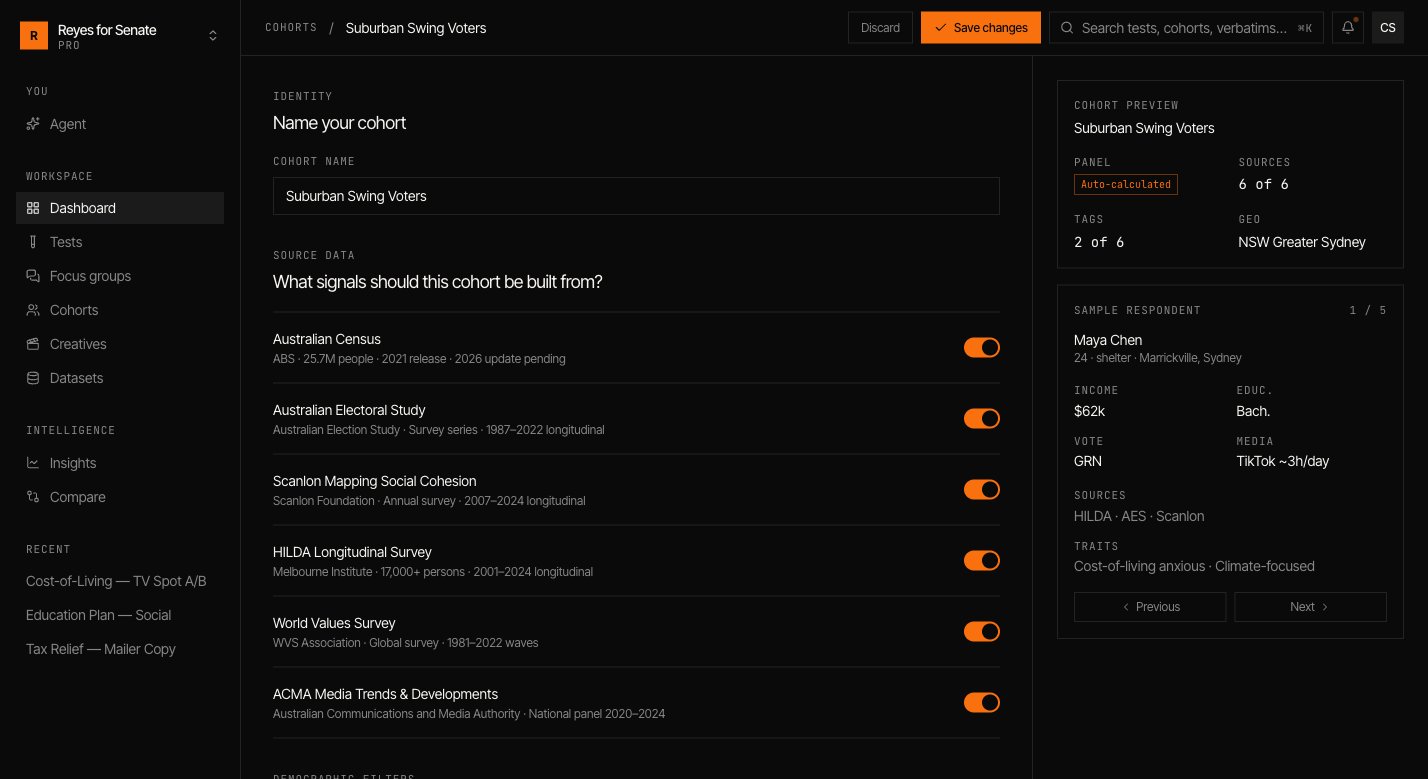
Traceable by design
Because personas are grounded in named sources, results are auditable:- A cohort records which datasets it’s built from.
- A test records the cohort, the sample, and the real-world context of the run.
- Verbatims and metrics carry the reasoning behind them, not just a score.
Grounding is what makes Simulant defensible in high-stakes work — campaigns, cabinets, and boardrooms — where a decision has to be explained, not just asserted.
Validation
In a blind back-test, Simulant reproduced a national attitudes study — six months of fieldwork — in a single night. Where the simulated results diverged from the survey, follow-up found Simulant was closer to the truth.Add your own data
Ground the population in signal specific to your market.