> ## Documentation Index
> Fetch the complete documentation index at: https://docs.simulant.tech/llms.txt
> Use this file to discover all available pages before exploring further.
# Core concepts
> The building blocks of Simulant — workspaces, datasets, cohorts, creatives, tests, and focus groups — and how they fit together.
Simulant has a small set of objects that build on each other. Understanding how they relate makes everything else in these docs straightforward.
 ## The object model
A **dataset** is a source of real-world signal — census figures, electoral studies, panels, or your own uploaded data. Personas are built from datasets, so every response can be traced back to evidence.
A **cohort** is a defined audience drawn from your datasets and narrowed with demographic filters and psychographic tags. It has a sample size (`n`).
A **creative** is the thing being reacted to — a video, an image, or a block of copy.
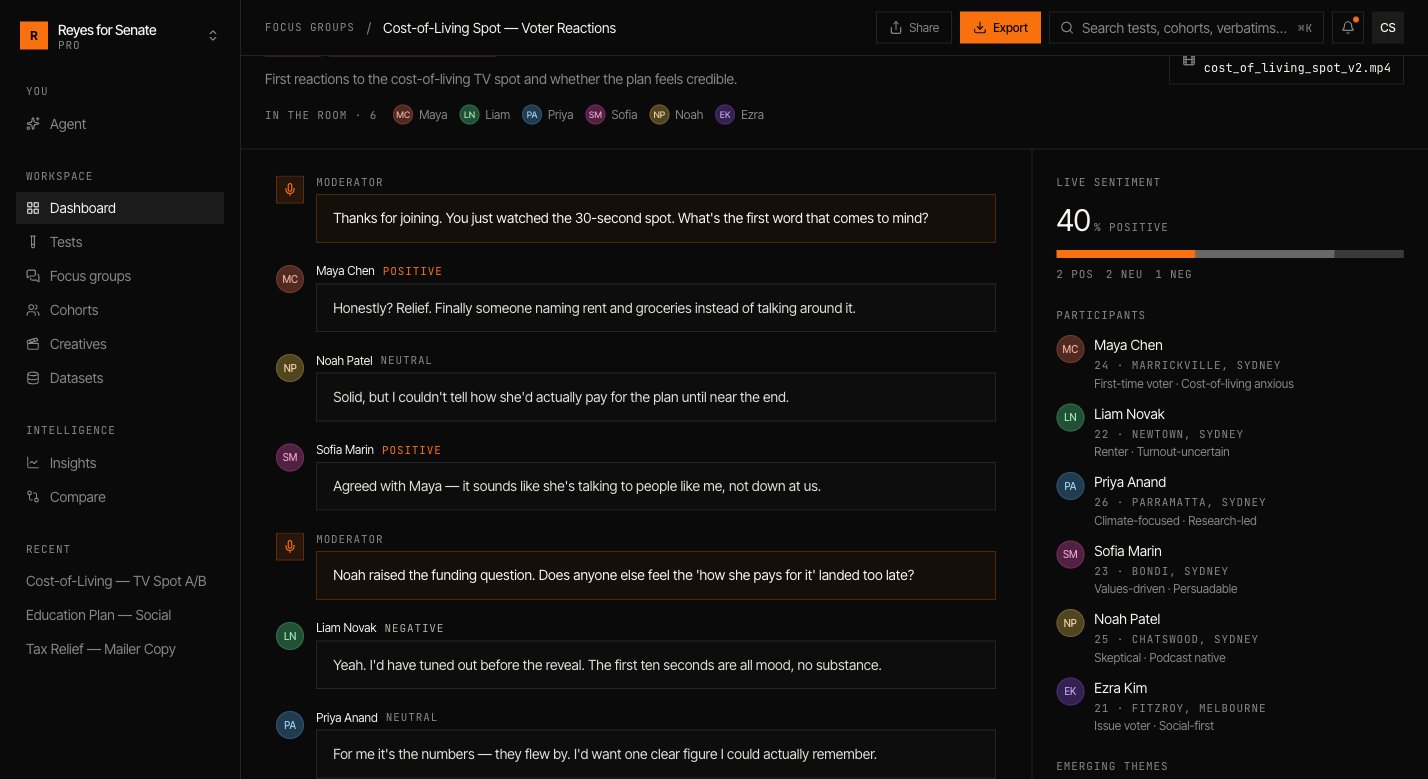
A **test** runs a structured study across the whole cohort. A **focus group** convenes a small room from the cohort to deliberate in conversation.
## Objects at a glance
| Object | What it is | Where it lives |
| --------------- | -------------------------------------------------------- | ---------------------------- |
| **Workspace** | The shared space for your team's work, data, and billing | Workspace switcher, top-left |
| **Dataset** | A source of grounding data, versioned with a schema | **Datasets** |
| **Cohort** | A defined, sampled audience | **Cohorts** |
| **Creative** | A media asset or copy to test | **Creatives** |
| **Test** | A structured study run across a cohort | **Tests** |
| **Focus group** | A convened room that deliberates | **Focus groups** |
| **Insight** | A pattern surfaced across many tests | **Insights** |
## Workspaces
Everything you create belongs to a **workspace**. A workspace has its own datasets, cohorts, tests, members, plan, and billing. You can belong to more than one and switch between them with the switcher in the top-left of the sidebar. See [Members and roles](/workspace/members).
## Quantitative and qualitative, together
Every test returns both kinds of feedback:
* **Quantitative** — structured measures such as recall, sentiment, purchase intent, and clarity, scored out of 100 and cut by segment.
* **Qualitative** — open-ended **verbatims** (what individual personas said and why), clustered into **themes**, with **recommendations** distilled on top.
A [focus group](/guides/focus-groups) adds a third mode: watching a room reason and shift its position live.
## Grounding
Simulant models outcomes, not opinions. Personas are built from the measurable record, and every result traces back to the signals behind it — so the read-out survives the room, the audit, and the front page. See [How grounding works](/data/grounding).
Start by building the cohort you want to reach.
## The object model
A **dataset** is a source of real-world signal — census figures, electoral studies, panels, or your own uploaded data. Personas are built from datasets, so every response can be traced back to evidence.
A **cohort** is a defined audience drawn from your datasets and narrowed with demographic filters and psychographic tags. It has a sample size (`n`).
A **creative** is the thing being reacted to — a video, an image, or a block of copy.
A **test** runs a structured study across the whole cohort. A **focus group** convenes a small room from the cohort to deliberate in conversation.
## Objects at a glance
| Object | What it is | Where it lives |
| --------------- | -------------------------------------------------------- | ---------------------------- |
| **Workspace** | The shared space for your team's work, data, and billing | Workspace switcher, top-left |
| **Dataset** | A source of grounding data, versioned with a schema | **Datasets** |
| **Cohort** | A defined, sampled audience | **Cohorts** |
| **Creative** | A media asset or copy to test | **Creatives** |
| **Test** | A structured study run across a cohort | **Tests** |
| **Focus group** | A convened room that deliberates | **Focus groups** |
| **Insight** | A pattern surfaced across many tests | **Insights** |
## Workspaces
Everything you create belongs to a **workspace**. A workspace has its own datasets, cohorts, tests, members, plan, and billing. You can belong to more than one and switch between them with the switcher in the top-left of the sidebar. See [Members and roles](/workspace/members).
## Quantitative and qualitative, together
Every test returns both kinds of feedback:
* **Quantitative** — structured measures such as recall, sentiment, purchase intent, and clarity, scored out of 100 and cut by segment.
* **Qualitative** — open-ended **verbatims** (what individual personas said and why), clustered into **themes**, with **recommendations** distilled on top.
A [focus group](/guides/focus-groups) adds a third mode: watching a room reason and shift its position live.
## Grounding
Simulant models outcomes, not opinions. Personas are built from the measurable record, and every result traces back to the signals behind it — so the read-out survives the room, the audit, and the front page. See [How grounding works](/data/grounding).
Start by building the cohort you want to reach.